
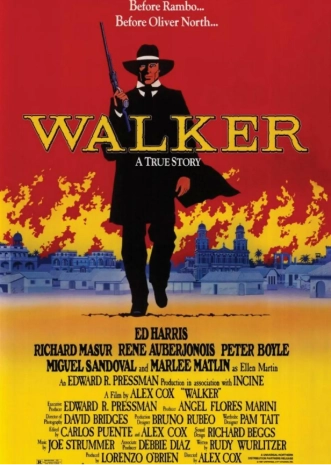
Looking at the poster, his black silhouette is the first thing that catches your eye. Against an emblazoned landscape, with his coat swaying in the wind and a rifle in his hand, he strides towards you with an air of stoic triumph, away from the carnage. His name is William Walker, and he never stops walking. Not even in one of the scenes that inspired the poster, when he and his troop of mercenaries, dubbed ‘Walker’s Immortals’, were ambushed during their invasion of Rivas, Nicaragua. As the members of his army drop like flies around him, Walker trudges on alone, unfazed and unscathed, as if pulled in by some invisible force deeper into the city. “I’m doing the only thing I know how to do – advance!”, he retorts to a dying lieutenant who, in his final breath, confronts the colonel on his floundering military strategy.
This mythos of the lone ranger, a longstanding icon of American culture, is one but many of the Western genre tropes in Walker, Alex Cox’s fascinating retelling of the real-life exploits of the eponymous American mercenary and filibuster. Walker infamously conducted an unauthorised military expedition into Nicaragua and reigned as its self-declared president from 1855 to 1857. He was a largely-forgotten figure in American history until more than a century later, when Cox visited Nicaragua and chanced upon a building with a plaque declaring itself as one of the rare few buildings standing after Walker’s fiery destruction of the city. In the midst of political turmoil in the region, instigated by US involvement in the Nicaraguan Revolution and the Iran-Contra Affair, Cox set out to make a film that criticises current U.S foreign policy in Central America by drawing parallels to Walker’s expansionism. And what better way to do so than through a time-bending reconfiguration of a well-worn and distinctly American genre?
The Western is one of cinema’s earliest and most enduring genres. The first widely-known commercial narrative film, The Great Train Robbery (1903), is a Western. Predating the birth of cinema, it had existed in popular songs, pulp novels and folk tales, constructing and formalising the mythology of the American West. Its iconography, such as the broad expanses of the Western frontier, and archetypal figures representing good (the cowboy) and evil (outlaws, Native Americans), had cemented itself into popular imagination by the time film became an established commercial art form. Because the genre only ever depicts past events, its historical nature and mythical quality have made it one of the most potent in examining contemporary values and attitudes.
 The Great Train Robbery (1903), dir. Edwin S Porter
This was the case for Cox, who saw in William Walker’s Icarian fall from grace an opportunity to comment on the then-current bloody civil war between the CIA-backed Contras, a right-wing militia, and the ruling Sandinistas in Nicaragua. Genre then becomes the lens through which Cox lambasts American neo-imperialism: Walker operates within the codes of the traditional Western just to dismantle the expectations of the genre, critically reflecting on the consequences of expansionism and Manifest Destiny—Western ideals that were espoused by Walker in his invasion of Nicaragua and similarly enacted by the US in their intervention in the civil war much later.
In the opening title sequence, the omniscient narrator introduces us to Walker by echoing familiar Western tropes about freedom, justice and Manifest Destiny:
“In 1853, a small group of Americans journeyed to Sonora, Mexico. Their mission was to free that country from a corrupt dictatorship. Their leader’s name was William Walker.”
From the beginning, Walker is singled out to embody the American rugged individualism of a typical Western hero. He and his Immortals are portrayed as brave adventurers on a dangerous quest to free innocent people from oppression. The audience is then thrust right into a Wild West-esque scenario, with men in cowboy hats and horses engaging in battle on a western desert. Setting the stage with reassuring clichés of westness, the film proceeds to disarm the viewer, unsettling the very foundations on which its narrative is based. Cox and screenwriter Rudy Wurlitzer use anachronisms to emphasise the artificiality of the Western setting: computers, contemporary magazines and Coca-Cola bottles make uncanny appearances, carrying traces of the present into the mythic West.
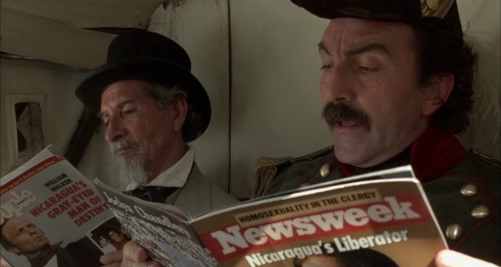
Army officials from the 19th century reading People and Newsweek magazines
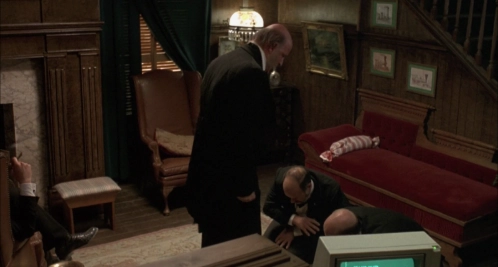
The top of a desktop at the bottom right of the frame, spotted in Vanderbilt’s office
Walker himself, in his traditional cowboy garb and Manifest Destiny rhetoric, might be emblematic of the Western mythic hero, acting as a revolutionary on a quest to free Nicaragua from oppression, but in reality is inflicting just that on the Nicaraguan people. Cox cites the 1973 neo-Western classic Pat Garrett and Billy the Kid (1973) as the main inspiration for Walker because, in both films, the protagonists “climb up a pile of dead bodies to achieve momentary fame and their own death.” Their self-serving natures vastly contrast the traditional heroes of classic Westerns, who embody a moral commitment to civilisation and serve as arbiters of justice. In fact, Cox takes it a step further by eliminating any possibility for Walker’s redemption. Far from the typical hero or anti-hero in other Westerns, Walker is completely unsympathetic. The character seems to abide by no moral code, descending into despotism solely to quench his thirst for power and conquest.
So what does this all say about tradition and modernity? It is far too simple to dichotomise both processes. The evolution of the Western genre perfectly demonstrates the interplay between both, and how their interactions create space for an improvement and a reimagination of the genre’s potentiality. In the book Post-Westerns: Cinema, Region, West (2013), Neil Campbell makes a case against the Western as an archaic and inaccessible genre, arguing that, in interrogating the very ideological frameworks that had conjured it into being in the first place, ‘post-Westerns’ offer alternative counterfictions that challenge the authoritative norm concerning the American West, while still maintaining a fidelity to its generic roots.
Like a post-Western, Walker interrogates the ideals promulgated by the traditional Western by doubly reflecting and subverting its inherited tropes. While the spirit of the Old West lives on in the film, it is only through it that it is able to break away from established structures, creating new forms that do not reproduce what is harmful from before. The uncanny intervention of anachronisms and Walker’s eerie similarity to certain political figures today[1] place the film in a liminal space between the past and present, creating a logical chasm that challenges the viewer and forces them to relook at what is ideologically taken for granted.
It is therefore unsurprising that the film would not be well received by audiences and critics alike: Cox is far from subtle in his condemnation of American neo-imperialism, and Ed Harris’ ‘half-charming, half-psychotic’ portrayal of Walker is not sympathetic at all for audiences to latch onto. Nonetheless, the film will forever be immortalised for its anarchic spirit and its unique positioning between the old and new worlds, rendering its political acuity all the more relevant and damning today.
Notes
[1] In an interview with the Alliance of Global Justice in April 2025, Cox likens Walker to Pete Hegseth, the current Secretary of Defense for the United States.
References
Campbell, N. (2013). Post-Westerns: Cinema, Region, West. University of Nebraska.
About the Author
Charlotte is the Archive Officer at Asian Film Archive, our partner for Perspectives 2025. She previously headed the Programmes team at Perspectives, and interned at AFA while studying Public Policy and Global Affairs at NTU.