
Spoiler alert: this article discusses the film’s ending
While Japan has long had traditions of horrific and supernaturally-themed narratives of various kinds and mediums, the present continuing wave of Japanese horror films is one of the most significant for its exceptional global popularity and visibility, as well as for the contemporary resonance of the articulated themes which have contributed to that popularity. Many analysts would designate the release of The Ring (1998) as a starting point for the wave, the success of that particular film giving rise to releases of numerous Japanese films with strong thematic and stylistic affinities in the years to follow (and in many cases garnering concordant success). Among the best-known early examples of that wave are The Grudge (2000), Dark Water (2002), and the film being screened by Perspectives, Pulse (2001).
One key theme that connects many of these films is a haunting based upon some past wrong or injustice which is only in the present beginning to surface. In quite a few instances, the being angrily seeking a violent retribution for these past wrongs is a female ghost characterized by long dark hair obscuring her features and an ominous walk—a figure with earlier antecedents in Japanese horror traditions, but which became an internationally referenced (and sometimes even parodied) horror trope in the wake of The Ring’s ghostly figure of Sadako. While Pulse does partake of this trope (with its own horrifying female ghosts to give Sadako serious competition), its most significant connection to The Ring is in taking up that earlier film’s focus on new technology as a disruptive factor which facilitates human interaction with dangerous supernatural beings. While for The Ring, the technology is famously that of video players and televisions, for Pulse, it is internet-connected computers. More specifically, and presciently, Pulse plays on fears of computer interconnectivity and, at that early stage in the technology’s development, potential interactivity and virality, with ghostly beings in the computers’ internet realm spilling out into the lived reality of users and technicians in novel, destructive, and rapidly spreading ways.
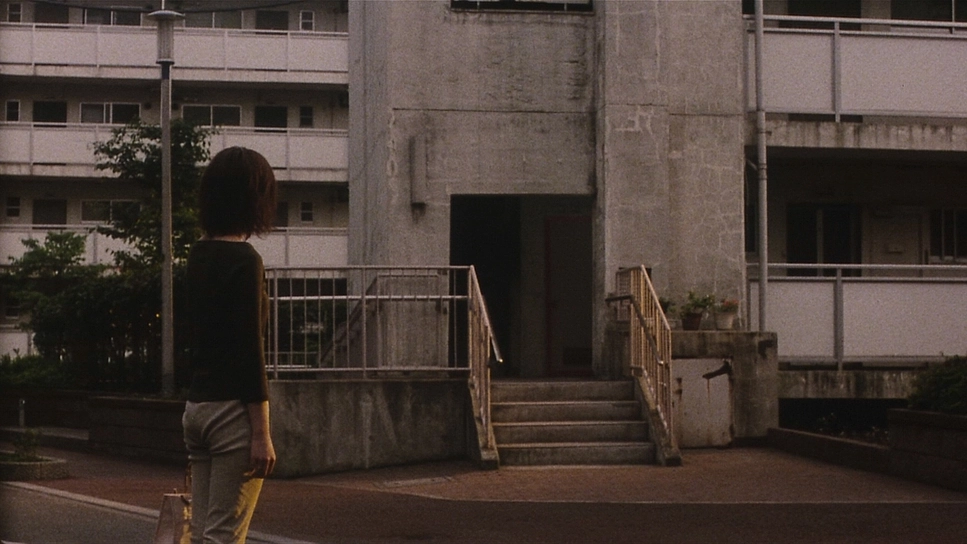
On first glance, Pulse might not seem to be the most obvious choice for a program on tradition and modernity, in that traditional Japan, and indeed much of Japanese tradition, appears to be conspicuously absent in the bleak landscape that is the film’s setting. Or rather, one could argue that the absence of tradition is precisely the point (and the way in which tradition is made present), the film being about a contemporary context in which traces of tradition are scarcely able to find purchase, and must be read through stand-ins for that absence: the few items or entities that have continuity from the past. One such entity is arguably the plant life which some of the main protagonists look after as their employment, one of the very few elements of nature (even if carefully cultivated) in the desolate visual and narrative fields of the film. And another group of entities with links to the past, and which are narratively much more prominent, are the ghosts who are evidently working to force their way into the film’s present-day Japan. Their numbers (the weight of the past?) are such that more space is required for them, and more recently emerging technologies are providing a means to access such space.
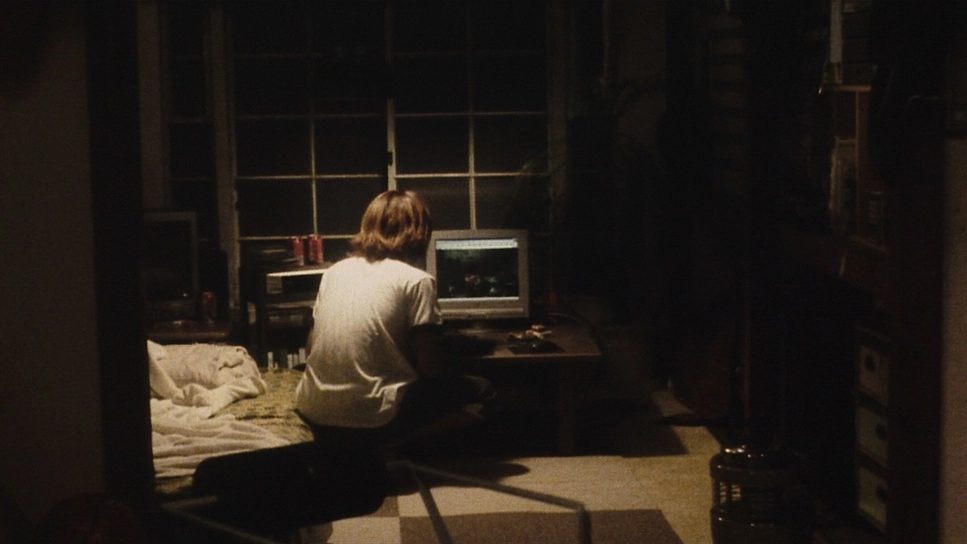
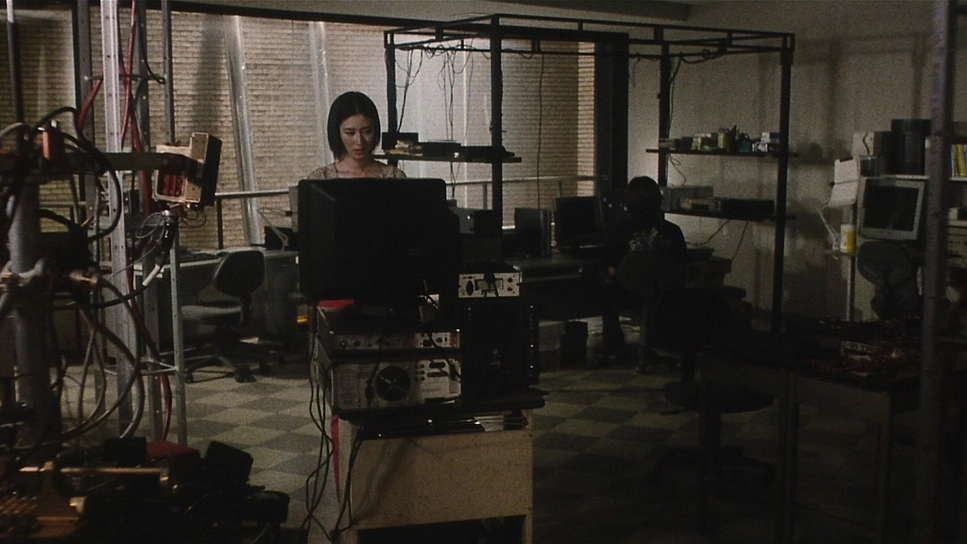
The conspicuous absence of tradition, however, is more than matched by an overwhelmingly present—but dismal—modernity. The modern setting that pervades Pulse is not one of gleaming innovative structures and future-oriented cities, but of ageing, nondescript non-residential buildings and bleak, seemingly disused warehouses, factories, utility plants. (One of the few exceptions to this occurs in shots of a modern Tokyo cityscape close to the film’s conclusion, but the precise point there is that the cityscape has by this point been emptied of people, and thus itself comes to embody another dead space.) Even the novel technology that seems to have precipitated the film’s crisis (in the form of a ghost invasion) is presented in a form that makes it seem decrepit, decaying, broken—low-lit rooms full of monitors and drives and software, all evidently tending to malfunction, to be already corrupted. And going hand-in-hand with this sense of modernity as a failed or collapsing project is the recurrent reference to the characters’ emotional and psychic distress, including suicidal ideation (evidently actively caused by the interventions of the ghosts) and an inability to make sense of the seemingly inexplicable events suddenly taking place all around them, the various obscure clues they manage to glean notwithstanding.
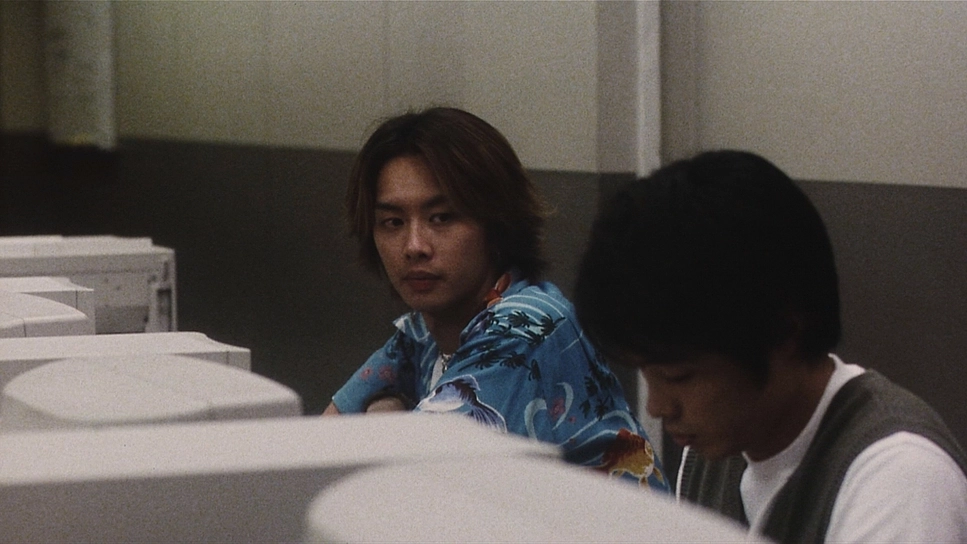
As viewers, we are placed to share in this kind of confusion owing to the film’s narrative construction. Pulse regularly withholds classical-style exposition of the causality among events, leaves opaque the nature of the bizarre phenomena we (and the characters) witness, and unclearly shifts in time and space between one narrative occurrence and the next. The plot of Pulse is one that is by design difficult to apprehend, and the loss of a clear sense of narrative drive and temporal direction is fully in keeping with the film’s bleak figuration of a society under collapse, its futurity suddenly suspended by the rise of inexplicable forces evidently connected to new technologies.
The loss of a forward-moving temporality is articulated via the film’s larger circular flashback structure as well: The film’s sombre opening images of a mysterious woman staring out to sea from a ship’s railing turn out to be the likely site of the film’s act of narrating (by said woman, the last of the surviving main protagonists, who has now fled Japan), to which we return at Pulse’s closing. The film leaves open the final conclusion of events, however, suggesting it’s not fully a fait accompli and that there may be some hope for the future in searching, outside of Japan, for some place where the mysterious forces of ghosts and new technology have not yet taken hold. But there is also some hope intimated in the small amount of interpersonal connection we see getting forged between the narrator and the ship’s captain, a connection which rhymes with others we have seen characters attempt to develop time and again throughout the apocalyptic narrative, as a means of pushing back from the destructive influence of ghosts. It is at the point of the failure of such human connections—owing, seemingly, to the sway of viral technologies and malevolent spectral beings—that living humans literally disintegrate in Pulse; and thus by implication the project of nurturing and protecting such connections holds out possible hope in averring the kind of psychic apocalypse the film envisions.
About the Author
Adam Knee has published widely on popular film, especially in the field of Southeast Asian cinema.
Holding a PhD in Cinema Studies, he is currently Dean of the Faculty of Fine Arts, Media and Creative Industries at Lasalle College of the Arts.