
This article contains spoilers.
Last year, I visited a fan-curated exhibition in memory of Leslie Cheung in Guangzhou, China. I was drawn to a model of a Peking Opera theatre. The curtain patterns, the uneven rows of seats, and the crumbs on the tables made me feel like I could almost sense the smell and noise of the theatre. I could even hear Cheng Dieyi (Leslie Cheung) and Duan Xiaolou (Fengyi Zhang) singing their fates. My thoughts returned to 1993, when Farewell My Concubine (dir. Chen Kaige, 1993) won the Palme d’Or at Cannes. The world witnessed the peerless brilliance of Leslie Cheung. In 2025, 22 years after his passing, I want to revisit his stardom, which has long transcended time and space.
 The model of the theatre
Twenty-two years is not an end, but a beginning. Leslie Cheung has never truly left. He still exists: in every replay of his films, in every chorus of his songs, and in every soul that has been moved by his performance, voice, beauty, and love towards life. This is the ultimate meaning of remembrance: not to preserve a vanished splendor, but to let the splendor keep growing; not to freeze time, but to awaken an eternal spirit.
Farewell Dieyi: The Concubine on Stage
The opening sequence of Farewell already foreshadows Dieyi’s tragic destiny: two diminished figures in a vast empty stadium, swallowed by the sweep of history. The door closes. The spotlight falls. The stadium turns into a stage. After 22 years, Dieyi and Xiaolou perform together once more in the light, as if time itself had condensed into this lonely performance. Only silence remains. The story then turns back to 1924, when they first met. We experience 53 years of 20th-century Chinese history through Dieyi and Xiaolou, witnessing love and betrayal, and the tragic fate of individuals caught in grand historical narratives. At the moment when Dieyi draws the sword and takes his own life, he becomes the Concubine Yu (Yu Ji) on stage.
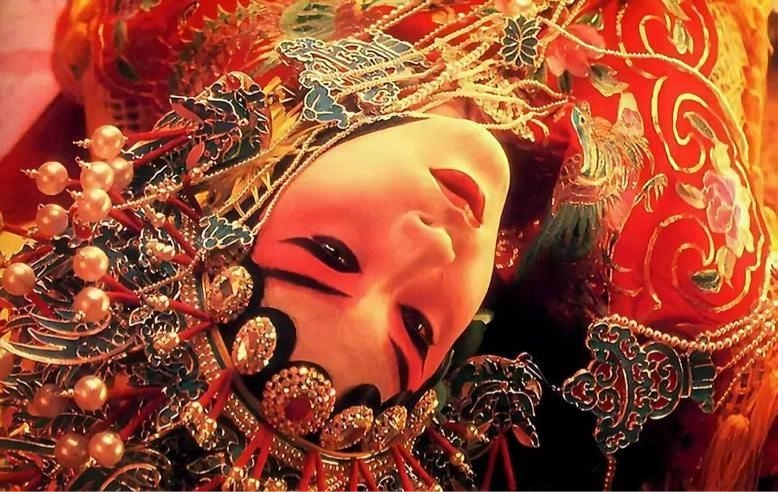 Cheng Dieyi’s Yu Ji
Yu Ji can be read in three layers. The first is the dan tradition of cross-dressing in Peking Opera, where male actors perform as female characters. Mei Lanfang’s celebrated interpretation shifted the focus from King Xiang Yu to Concubine Yu, transforming her from a marginal figure in a masculine war story into the center of its tragic narrative. The second layer is Dieyi’s identity and performance. Dieyi gradually merges his own identity with that of Yu Ji, until the role becomes an extension of his life.
The third layer comes from Leslie Cheung himself. In a speech, Cheung explained that the film’s ending, Dieyi’s suicide, was not in the original novel but conceived by himself together with Fengyi Zhang. He gave three reasons: Yu Ji’s devotion to die before her king, the need to complete the original story, and Dieyi’s refusal to face the passing of youth and the ravages of reality upon art and the soul. Director Chen Kaige’s films often explore the individual’s struggle against history. Leslie Cheung’s performance and life gave this motif flesh and blood. Like Dieyi, who devoted himself to the stage and resisted being swallowed by the tide of history, Cheung too chose to confront himself with honesty, departing at the height of his brilliance. He gave Farewell My Concubine its deepest resonance of tragic beauty. His gentleness and radiance, his love of stage and performance, and his final resolve all unified the world of cinema with the world beyond it.
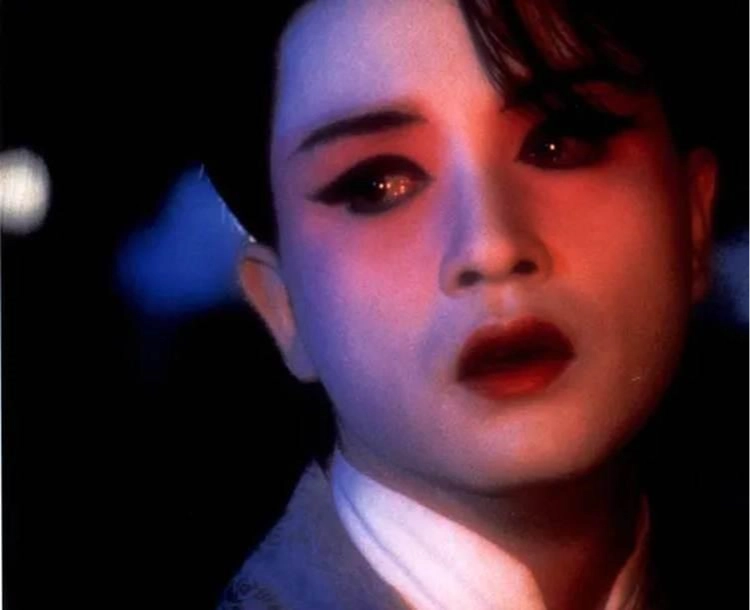 Leslie Cheung’s Cheng Dieyi
Silence becomes the best footnote of history. Yu Ji’s suicide inscribed a heroic stroke in history, while Dieyi’s suicide shows the fragility of modernity. Yu Ji, Dieyi, and Leslie Cheung, all figures of utmost sincerity, at once worldly and otherworldly, together compose a requiem of idealism.
Farewell My Gor Gor: Leslie Cheung Forever
I am myself
a firework burning in a different hue.
Beneath the endless sky and sea,
I choose to be the strongest bubble.
I like myself,
letting roses bear a different fruit,
blooming naked and unyielding,
even in the desolate desert.
——Leslie Cheung “Me”
Leslie Cheung’s 2000 song Me is a self-portrait. Firework and rose are the two forms of his life. In both performance and life, he showed the passion of fireworks. To shape the role of Dieyi, he shut himself away for half a year to study Peking Opera, perfecting every gaze and movement. His final performance in the film became an explosion of resonance between actor and character. Dieyi’s sacrificial act mirrors Cheung’s own devotion to performance, full of sincerity, emotions and passion, burning as fireworks. And when Dieyi becomes the true Yu Ji and takes his life, it is like fireworks vanishing into the night, blazing yet fleeting.
On stage, he was a true superstar. Like a wild rose in the desert, he possessed a vigorous and unyielding vitality, lonely, yet brave. He was brave enough to appear in feminine costumes, to try avant-garde styles, and to declare his love openly to his same-sex partner. His courage in gender expression makes him one of the most pioneering figures among Chinese stars. He is free. His performances on stage, on screen, and off screen have broken the boundaries of socially-constructed gender norms, full of resistance, rebellion, and freedom.
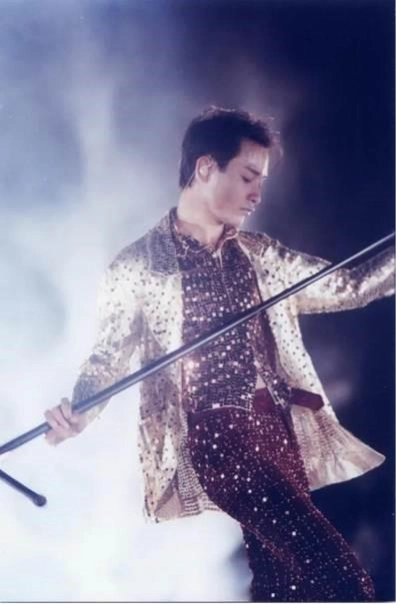 Leslie Cheung on stage in 1997
Off stage, his courage also lay in his gallant and righteous spirit. He gave warmth and support to everyone around him, spared no effort to help and guide newcomers, treated his fans with generosity, and even stood up for his Peking Opera teacher who suffered from domestic violence. For this, he earned the nickname “Gor Gor”, which means an elder brother who always stands up for others.
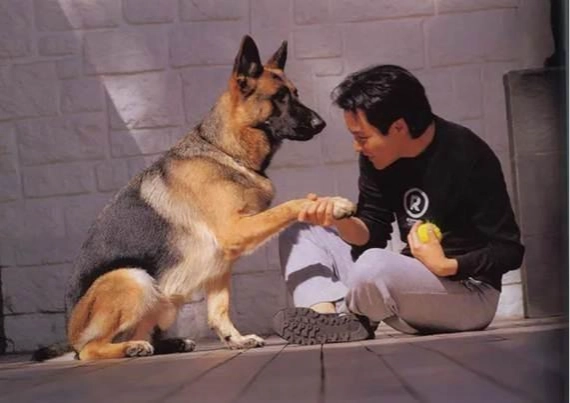 Leslie Cheung off-stage
He is a true transnational icon in the golden era of Hong Kong pop culture, having held 10 consecutive concerts in Japan, served as a jury member at the Berlin International Film Festival, named by CNN among the “Top 25 Greatest Asian Actors of All Time,” and received numerous brand endorsements in Korea. Yet all this brilliance stopped suddenly on April 1, 2003. He once said that his life is much happier than Dieyi’s, but at that moment, his life seems to echo Dieyi’s.
Waves of popular culture have come and gone during the past 22 years, yet people from all over the world still remember Leslie Cheung every April and September (his birthday is on September 12th). In recent years, he has also gained more and more young fans, who find in him a sincerity and beauty that speaks across generations. There are always flowers on his name in Avenue of Stars, outside of Mandarin Oriental Hotel, or in front of School of Design, University of Leeds, his alma mater. Fans have also produced their own communities and alternative identities. There are Hanyuan Bookstore in Shanghai and Zhongqing Cafe in Chengdu in memories of Leslie Cheung. There is fan community LeslieClub (Rong Men Ke Zhan) organizing online and offline events. When the fireworks fade, he turns into a sky full of stars. In this way, Leslie Cheung’s light continues to guide us, transcending time and space.
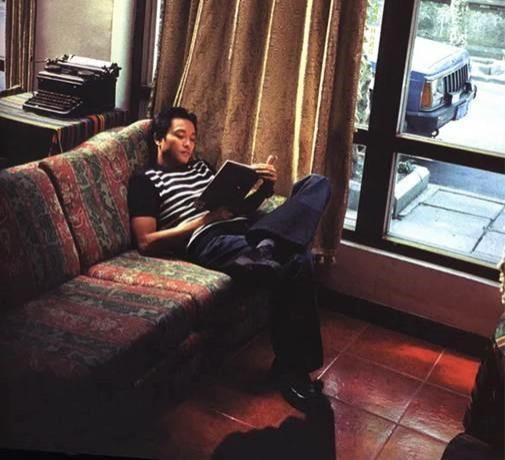 Leslie Cheung in Hanyuan Bookstore in 2000.
The bookstore closed in 2017 and later reopened at another location.
Why do we still remember Leslie Cheung? The answer lies in our hearts: when he raised the sword on screen as Cheng Dieyi; when we swept through the night watching A Better Tomorrow; when his voice echoes again and again in our memories; when we look up at the stars in the night . . .
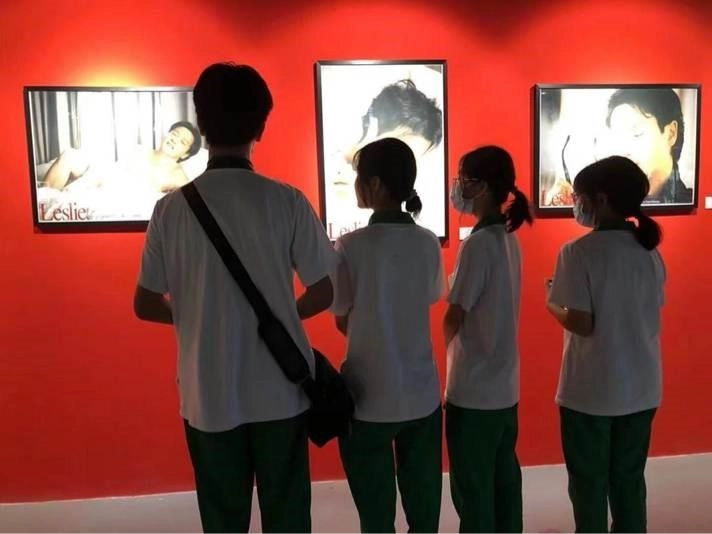 Teenagers visiting a Leslie Cheung exhibition, showing how his influence continues across generations.
Photo by Jiang Yueye, used with permission of those photographed.
In those moments of beauty, truth, and love, something has already crossed the boundary of life and death, crystallizing into a cultural amber beyond time. He made the spirit of “Gor Gor” transcend generations: in an age driven by internet celebrities, he built a legend with sincerity; in an age ruled by algorithms, he defended the unmeasurable with eternal beauty. When fans meet him again in cinema, echo his voice in song, or find him in the words they write, they take part in a transmission that crosses time and space. This inheritance is not confined to an era. It sails on art, rows with sincerity, and carries each generation’s longing for beauty toward the shore of eternity.
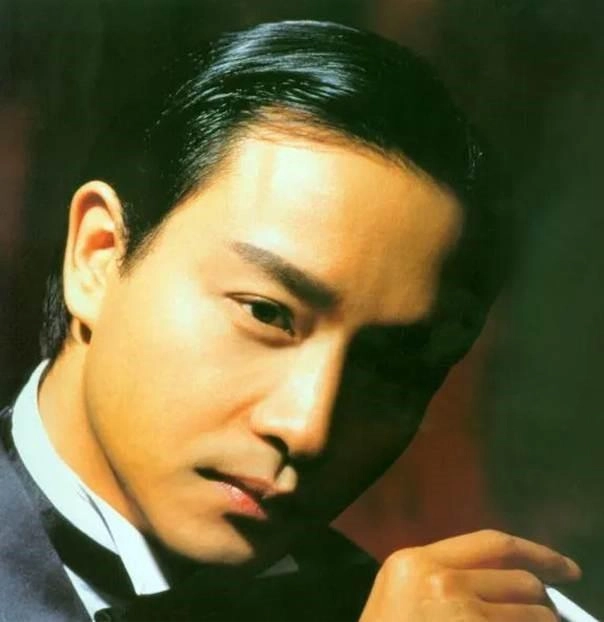 Leslie Cheung is in our hearts forever.
About the Author
Xueyan is a PhD candidate in Cultural Studies in Asia at NUS. She has done extensive research and film writing on her interest in Chinese and Southeast Asian cinema.